
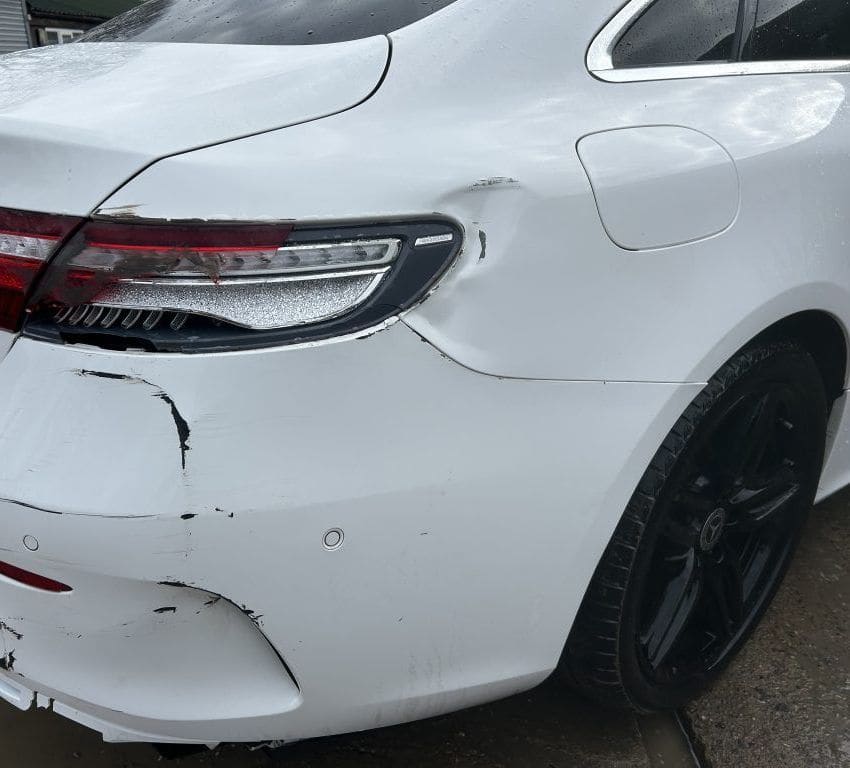
Stop in a safe place, check everyone is unhurt, swap names, addresses and registration numbers, and take photos. Then tell your insurer, even if you do not plan to claim. If details were not exchanged, or anyone was hurt, the police need to know. This is general information, not legal advice.
A minor accident is usually a bump in a car park, a tap at a junction or a scrape in a narrow lane. Nobody is hurt and the cars can be driven. You still have a few jobs to do, and doing them in the right order saves arguments later. This page is general information from a body shop, not legal advice. If you are unsure about the law, ask your insurer or a solicitor.
What do I do at the roadside?
Safety comes first. If you can, stop in a place of relative safety, switch off the engine and put your hazard lights on. The government's Highway Code also tells drivers to ask others involved to switch off engines and not to smoke.
Then check people before cars. Is anyone hurt, dizzy or in pain? If so, call 999 and give the exact place. Do not move anyone who is injured unless they are in danger where they are. The Highway Code's first aid pages cover the basics until help arrives.
If it really is a minor knock and the road is not blocked, move the cars to the side if it is safe to do so, but take a quick photo first if you can. Do not drive off just because it looks small. Stopping is a legal requirement when there is damage or injury.
Who do I have to give my details to?
The Highway Code says that if a collision causes damage or injury to another person, vehicle, animal or property, you must stop. You must give your name and address, the vehicle owner's name and address, and the vehicle's registration number to anyone with reasonable grounds to ask. That usually means the other driver, or the owner of a parked car or a wall that you hit.
Swap more than the bare minimum. Most guides, including the AA's advice, suggest taking:
- The other driver's name, address and phone number.
- Their registration number, and the make, model and colour of their car.
- Their insurer's name and policy number.
- Names and numbers of any witnesses.
- If the other driver is not the owner, the owner's details too.
If you hit an unattended car and cannot find the owner, leave a note with your details where it will be seen, and then still tell your insurer.
What should I photograph and write down?
Photos cost nothing and settle a lot of disagreements. Take wide shots that show where both cars are, then close-ups of every mark, even ones that look old. Photograph the road, any signs and the weather. Note the time, the date and what happened while it is fresh. If you have a dash cam, save the clip before it is recorded over.
Do not say sorry or take the blame at the scene. The AA points out that an apology can affect who is held responsible, and it is for the insurers to work that out. Be polite and stick to the facts.
When do I have to tell the police?
For a minor accident where you swapped details, nobody was hurt and nothing suggests a driving offence, there is often nothing to report to the police. The Highway Code is clear on two points, though:
- If you did not give your details at the scene, you must report the collision to the police as soon as reasonably practical, and within 24 hours at the latest.
- If someone else was injured and you did not show your insurance certificate at the scene, report it to the police as soon as possible and within 24 hours. You then have seven days to show your certificate at a police station.
Ring 999 if someone is hurt or the road is blocked. The AA also lists a driver leaving without giving details, or a suspicion that the other driver is uninsured or unfit to drive, as times to involve the police. For anything that is not an emergency, 101 is the usual number.
When do I tell my insurer?
As soon as you reasonably can, and that applies even if you do not plan to claim. Which? says to notify your insurer in all cases, because an incident you thought was nothing can turn into a claim later, for example if the other driver reports an injury. Policies differ on how quickly you must report, so check your policy booklet for the time limit and the phone number.
Having the other driver's details and your photos to hand makes that call short. Telling your insurer is not the same as making a claim. Whether to claim at all is a separate choice, and we cover that on our page about claiming for a scratch or dent.
Can I drive the car afterwards?
Look it over before you set off. Check the lights, the number plate, the bumper fixings and the tyres, and look underneath for fluid. A bumper hanging off, a wheel rubbing the arch or a warning light on the dash means the car should not be driven. Call your breakdown cover instead.
If the car seems fine, it may still be worth having it looked at. Plastic bumpers can hide cracked brackets, and a dent can sit over a bent panel edge. A photo sent to a body shop is a quick way to find out what you are dealing with.
Who repairs the car?
You will often hear from your insurer about repairs. In many cases you can choose your own repairer, and we explain what to check in choosing your own repairer. Whoever you pick, ask for a written quote and keep your photos. Our page on what a repair quote should include will help.
We are in Smallfield, near Horley and Gatwick, and we handle accident repairs as well as bumper repair and general body work. Many accident jobs are a scuffed corner or a cracked bumper, and those are things we see every week.
Getting a price from us
If you have had a knock, send photos to us on WhatsApp 07724 146 809, ring 01342 649 362 or email info@ericraft.co.uk. For the quick jobs we can usually reply with a price from the photos. If we cannot tell from a picture, we will say so and ask you to bring the car in. The quote is free with no obligation. Details are on our contact page.
Questions people ask
Do I have to report a minor accident to the police?
Not always. The Highway Code says you must report to the police, within 24 hours, if you did not give your details at the scene. Injuries and suspected offences are also reasons to ring them.
Should I tell my insurer if I am not going to claim?
Yes, in most cases. Which? advises telling your insurer about any incident, because it may lead to a claim later. Check your policy for the exact wording.
Should I admit fault at the roadside?
It is better not to. The AA advises against apologising or accepting responsibility until the facts are clear, because it can affect liability. Stick to swapping details and taking photos.
What if the other driver will not give their details?
Take their registration number, photos of the car and any witness names, then report it to the police. The Highway Code puts the limit at 24 hours. Your insurer can also help trace them from the registration.
Can I get a repair price before I speak to my insurer?
Yes. A body shop can look at photos and tell you roughly what the repair involves. That helps you decide whether to claim at all.
Sources and further reading
- Highway Code, breakdowns and incidents (rules 274 to 287), GOV.UK
- Highway Code, Annex 7 first aid on the road, GOV.UK
- What to do after an accident, The AA
- Making a car insurance claim, Which?
This page gives general information, not legal or insurance advice. Check your own policy and the official pages above.