
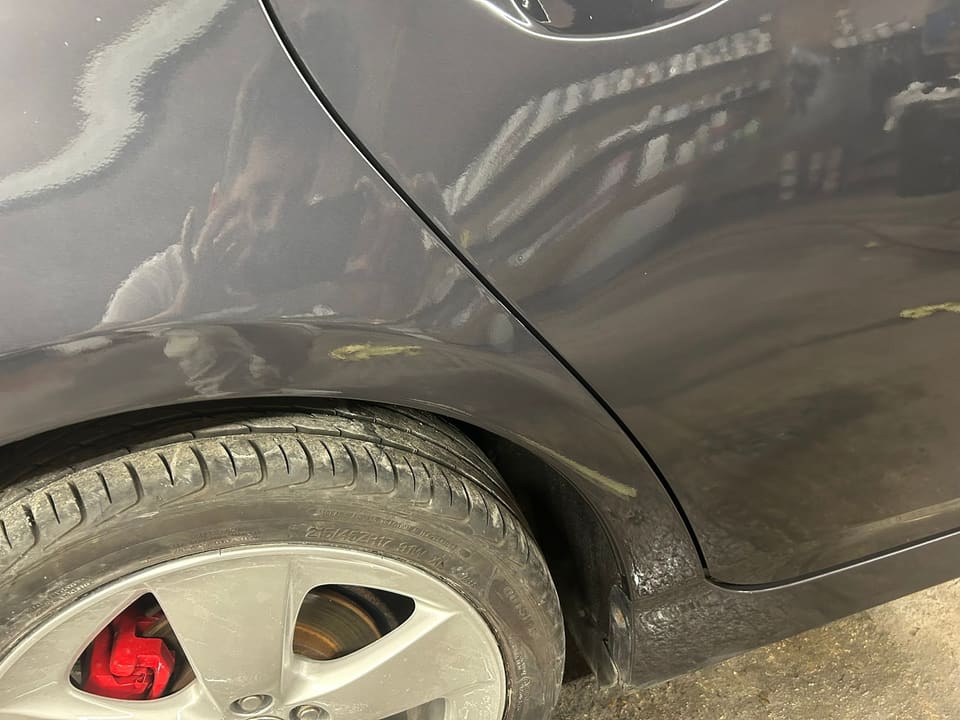
Scuffs and scrapes on the rim edge are usually cosmetic and can be refurbished. A bent wheel, a crack, or a tyre that keeps losing air needs checking before anyone paints over it, and some wheels should be replaced.
Almost everyone who drives in a town ends up kerbing a wheel at some point. Most of the time it leaves a scrape along the rim edge and nothing worse. Sometimes the knock goes deeper. The useful question is whether the wheel has only lost some paint and metal at the surface, or whether it has been bent or cracked.
Cosmetic damage can be refurbished. Anything that affects the shape or strength of the wheel needs a proper check first, and in some cases the right answer is a new wheel.
What does kerbing do to an alloy wheel?
An alloy wheel is made of aluminium alloy, which is light and holds a shape well, but it is softer than steel. When the rim edge scrapes a kerb, the paint or lacquer is scraped off and a little metal can be dragged away with it. That is the scuff you see.
A harder hit can do more:
- Gouges where chunks of metal have gone.
- A flat spot or bend in the rim, where the wheel is no longer round.
- A crack, often starting at the edge or near a spoke.
- Damage to the tyre sidewall, which is separate from the wheel and worth looking at while you are there.
How can I tell if it is just cosmetic?
Run a fingertip around the rim edge. If it feels rough, but the shape is even and the wheel looks round, it is probably surface damage. You can also check these things:
- Does the car vibrate or pull to one side since the knock?
- Does one tyre lose air more quickly than the others?
- Can you see a line in the metal that looks like a hairline crack?
- Does the rim look flattened in one place when you look at it from the side?
Any yes means the wheel should be checked before it is painted. We cannot judge this from a photo, so we will want to look at the wheel in person.
Is a bent or cracked wheel a safety issue?
It can be. The government's MOT inspection manual for cars treats any fracture or welding defect on a wheel as a dangerous defect, and a wheel that is badly distorted as a major defect. A wheel that is distorted enough to be likely to come off the car is also in the dangerous category.
That is the official standard for the MOT test. It is a good reason not to treat a wheel with a crack or a bend as a cosmetic job. If you think yours might be cracked, get a specialist to look at it before you drive far.
What does alloy wheel refurbishment involve?
In general terms, a cosmetic refurbishment follows the same pattern as any paint repair. You can see how we handle the general order on our page about how a body shop repair works. For a wheel it usually goes like this:
- The wheel is cleaned and inspected for damage.
- Scuffs and gouges are sanded back and filled where needed, so the rim edge is round and smooth again.
- The wheel is primed.
- The colour is sprayed, usually to match the original finish, and lacquered.
- The paint is left to harden, and the wheel goes back on the car.
Wheels with a diamond-cut finish, which has a shiny machined face, are a different case. They need the machined surface dealt with as well as the paint, so we would look at those individually. Our alloy wheel refurbishment page lists what we do.
When should a wheel be replaced instead?
Replacement, or at the least a specialist assessment, makes sense when:
- There is a crack, particularly around the spokes or the inner part of the wheel.
- The wheel is bent enough to cause a vibration or a slow leak at the tyre.
- Gouges are deep enough to have taken a good deal of metal out of the rim.
- A previous repair has already been done to the same area.
Repairers differ on how far a damaged wheel can be straightened or welded, and the answer depends on where the damage is. We would rather say a wheel should be replaced than paint over a fault.
Is a scuff worth fixing at all?
A scuff on its own does not stop the wheel working. But bare metal on the rim can start to corrode, and scuffed wheels make a car look tired, which matters if you plan to sell. If only one wheel has a mark, a smaller repair on that wheel may be all that is needed, and our SMART repair service covers small, localised jobs.
The RAC makes a similar point about paint generally: light damage can be polished, but deeper scratches that reach bare metal can rust and need proper repair. The same logic applies to a wheel rim.
We are in Smallfield, near Horley and Gatwick. Our page on body repairs near Gatwick explains how to reach us.
Can I stop it happening again?
A few habits help. Leave a little more room when you pull in close to a kerb. Use the kerb view on your mirrors if your car has one. Watch the nearside on narrow lanes and in tight car park bays.
Getting a price from us
Send photos of the wheels on WhatsApp to 07724 146 809, ring 01342 649 362, or email info@ericraft.co.uk. You can also use our contact page. Take a close-up of each damaged wheel and one from the side so we can see the shape of the rim. The quote is free, with no obligation. If we think a wheel needs more than a cosmetic job, we will say so.
Questions people ask
Can kerbed alloy wheels be repaired?
Usually, yes, if the damage is to the surface. Scuffs and gouges can be sanded, filled, primed, painted and lacquered. If the wheel is bent or cracked, it needs checking first.
How do I know if my alloy wheel is cracked?
Look for a fine line in the metal, a tyre that loses air, or a vibration that was not there before the knock. A crack can be hard to see, so if you are unsure, have the wheel looked at.
Is it safe to drive on a kerbed wheel?
Surface scuffs do not stop a wheel working. A bent or cracked wheel is a different matter, and the MOT manual treats a fracture as a dangerous defect.
Can one wheel be done on its own?
Yes. A single wheel can be refurbished, though the finish should match the others, which we will check.
Do I need new tyres after kerbing a wheel?
Not always, but a hard kerb strike can damage the tyre sidewall. It is worth having the tyre looked at at the same time.
Sources and further reading
- GOV.UK, MOT inspection manual for cars, axles, wheels, tyres and suspension
- RAC, how to remove car scratches
- National Careers Service, vehicle body repairer
This page gives general information, not legal or insurance advice. Check your own policy and the official pages above.