
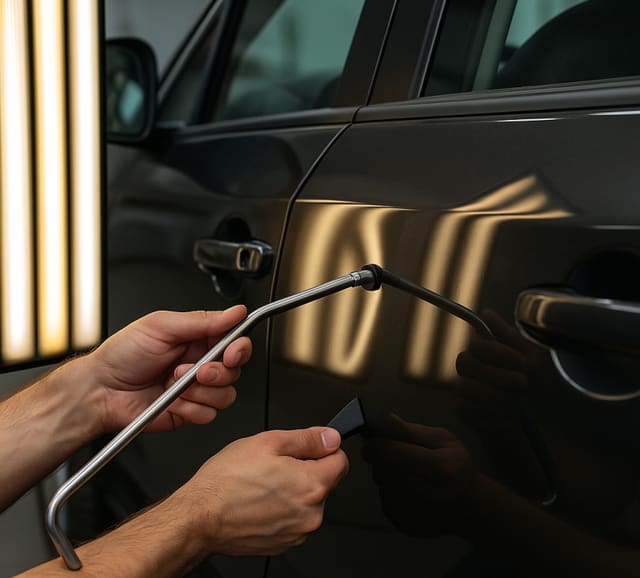
Paintless dent repair works from behind the panel and keeps your original paint, so it suits smaller dents with unbroken paint. Filling and respraying is the answer for sharp creases, cracked paint, dents at the panel edge and stretched metal.
There are two main ways to take a dent out of a car. One keeps your paint and works the metal back into shape from behind. The other fills and repaints the area. Which one is right depends on the dent, not on which sounds nicer.
If the paint is unbroken, the dent is not sharp, and it is away from the edge of the panel, paintless repair is often the better choice. If any of those is not true, filling and respraying is usually needed.
What is paintless dent repair?
Paintless dent repair, often shortened to PDR, is a way of removing a dent without filling, sanding or repainting. The technician gets behind the panel, or uses special tools to reach it, and massages the metal back to its original shape in small steps.
The RAC says PDR massages the metal back into shape, usually from behind the panel, and that because the original paint stays on, it is often quicker and cheaper than traditional bodyshop work. We offer it as part of our SMART repair service, which covers small, localised repairs.
What is filling and respraying?
This is the conventional route. The dent is pulled or tapped out as far as it will go, the remaining low spot is filled, and the area is sanded smooth. It is then primed and painted in the booth to match the car, with the new paint blended into the panel around it.
It takes more steps than paintless repair, and it changes the paint on that panel. In return, it can deal with damage that paintless repair cannot. Our dent repair page covers both approaches.
Which dents suit paintless repair?
In general, a dent is a good candidate when:
- The paint is intact, with no cracks or chips.
- The dent is smooth and rounded, like the mark left by a car door or a shopping trolley.
- It sits away from the edge of the panel.
- The technician can reach the back of the dent.
- The metal has not been stretched.
The RAC lists car park knocks, shopping trolley marks and hail damage as the sort of small to medium dents where the paint is still intact that PDR suits.
What makes a dent unsuitable for paintless repair?
These are the usual reasons:
- Cracked or chipped paint. If the paint has broken, the area needs priming and painting whatever happens to the dent. A trade article on paintless repair says plainly that cracked paint requires priming and painting.
- A sharp crease. A crease stretches the metal, and stretched metal does not go back by itself.
- A dent at the panel edge. Along the edges of many panels the metal is folded over or doubled, which makes it too stiff to move.
- No access to the back. If a technician cannot reach behind the dent, the panel may need a conventional repair.
- Old, brittle paint. The same trade article notes that older paint that has been dried out by sunlight is a poorer candidate, as it may crack when the metal is moved.
The RAC gives much the same list: PDR may not suit sharp creases, dents near panel edges, or damage where the paint has cracked or chipped.
A quick comparison
| Paintless repair | Filling and respraying | |
|---|---|---|
| Original paint | Kept | Replaced on that area |
| Suits | Smooth, shallow dents with unbroken paint | Creases, cracked paint, edge dents, stretched metal |
| Steps | Fewer | More: fill, sand, prime, paint, polish |
| Colour matching | Not needed | Needed, with blending |
| Panels it can reach | Where the back is accessible | Almost any panel |
What about dents on a bumper?
A plastic bumper is different from a metal panel. Some dents can be warmed and eased out, while others need plastic welding or filling. Our bumper repair page explains what we do, and our article on whether to repair or replace a bumper goes into more detail.
Can I tell from a photo which one I need?
Often we can give a good first view from a photo, particularly for small dents. For an honest answer we need to see the dent in the light, because shadows hide creases and edges. If the paint looks chipped in the photo, tell us. That one detail changes the answer.
If the dent is large, or the metal is creased, we may suggest the conventional route. We will say why, rather than suggest the lighter option and find it will not work.
What if the dent came with an accident?
A dent from a collision is often only part of the damage. There may be bent brackets or a cracked bumper behind it. We would look at the whole area before choosing a method. Our accident repair page explains how we handle that kind of job. The RAC lists dents among the damage covered under bodywork and accident repairs.
We are in Smallfield, near Horley and Gatwick, and the car park knock is the most common dent we see.
Getting a price from us
Send photos of the dent on WhatsApp to 07724 146 809, ring 01342 649 362, or email info@ericraft.co.uk. You can also use our contact page. Take one photo straight on and one from the side with some light across the panel, so we can see the depth. The quote is free, with no obligation.
Questions people ask
Can all dents be repaired without paint?
No. Paintless repair needs unbroken paint, access to the back of the panel and a dent that is not too sharp or too close to the edge. Other dents need filling and respraying.
Does paintless dent repair leave a mark?
When it suits the dent, the surface should come back to its original shape with the factory paint still on it. We will tell you if we think a mark may remain.
What happens if the paint is cracked?
The area needs priming and painting, so paintless repair is not the answer on its own. We would fill, prime and paint it, with colour matching and blending.
Is a dent on the edge of a door repairable?
Yes, but usually by the conventional route, because the metal at the edge is folded and stiff. We would look at it before saying more.
Should I claim on my insurance for a dent?
That depends on your policy, your excess and the cost of the repair. Check your policy and ask your insurer, and ask us for a quote so you can compare.
Sources and further reading
- RAC, how to fix a dent in your car
- Body Shop Business, Working Magic: Paintless Dent Repair
- RAC, book accident repairs
- RAC, how much does it cost to respray a car
This page gives general information, not legal or insurance advice. Check your own policy and the official pages above.