
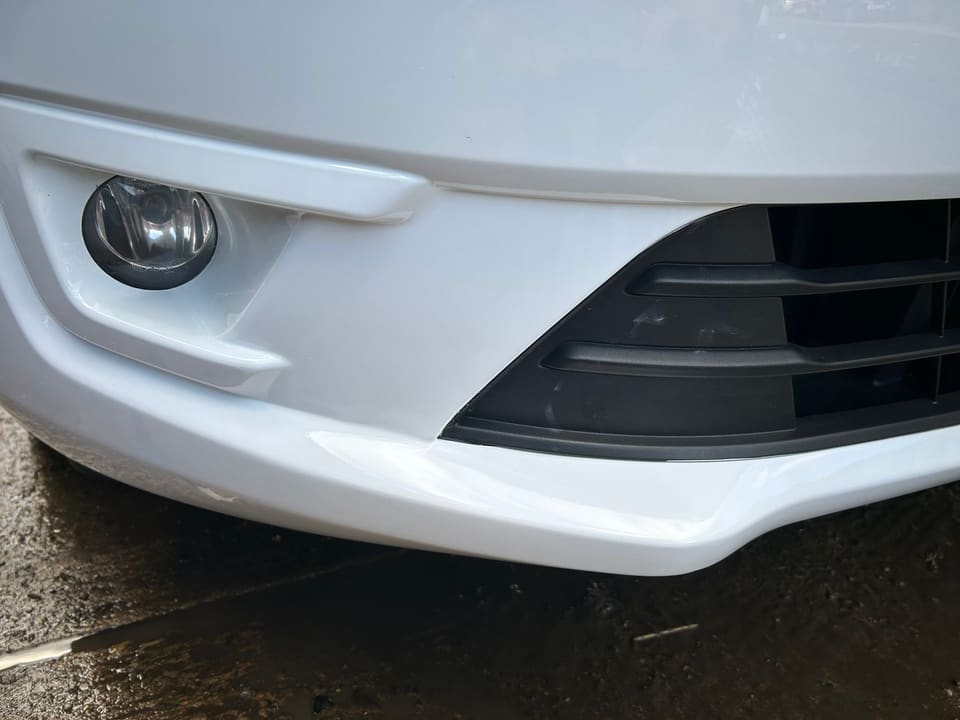
A plastic bumper with scuffs, small cracks and splits can often be repaired by plastic welding, filling and painting. Replacement makes more sense when the mounting points are broken, the plastic is badly shattered, or sensors behind it are damaged.
A cracked bumper is one of the most common things people bring us. The honest answer to "repair or replace" is that it depends on where the damage is, not just how big it looks. Scuffs, splits and small cracks in the plastic can often be repaired. A broken mount, a shattered corner or a damaged sensor behind the bumper often tips it towards a new one.
We are in Smallfield, near Horley and Gatwick, and a lot of the bumpers we see have come from car parks, tight drives and slow-speed taps. Most of those are worth looking at before anyone orders a new part.
What is a plastic bumper made of, and why does that matter?
Most modern bumper covers are moulded plastic, painted to match the car. Behind the cover sits a metal or foam beam that does the real work in a knock. The cover itself is mainly there for shape and finish.
Because it is plastic, it can be repaired in ways that metal cannot. A split can be joined using plastic welding, which means melting the plastic edges together, often with a strip of matching plastic added. After that the area is filled, sanded and painted.
What damage can usually be repaired?
These are the jobs we are normally happy to repair:
- Scuffs and scrapes where the paint has gone but the plastic is whole.
- Small cracks and splits that can be welded.
- Dents that can be eased back into shape.
- Holes from a previous bracket or fitting that need filling.
- Tabs and mounting points with a small break that can be rebuilt.
The RAC describes bumper work as fixing or replacing damaged bumpers, which can be dented, cracked or completely broken. Our bumper repair page goes through what we do for each kind of damage.
When does replacing the bumper make more sense?
Replacement is usually the better choice in these cases:
- The mounting points are broken. If the tabs and clips that hold the bumper to the car have snapped off in several places, the cover will not sit properly even if the outer plastic looks fine.
- The plastic is shattered. A corner that has broken into many pieces cannot be welded back into a strong shape.
- The bumper has been repaired before. Layers of old filler can make a second repair hard to get right.
- The reinforcing beam behind it is bent. That part is not the cover, and it needs checking separately.
- The sensors or cameras are damaged. More on that below.
We cannot tell which of these applies from a photo alone. A photo is enough for a first view. We will look at the bumper before saying for certain.
Do parking sensors change the answer?
They can. Many bumpers now carry parking sensors, and some carry radar or camera units for driver-assistance systems. These are often grouped under the name ADAS, which stands for advanced driver assistance systems.
The industry guidance is that sensors need to work properly after a repair. Thatcham Research, which works on vehicle repair methods, issued guidelines saying that if sensors, or parts close to them, are part of a repair, calibration must be completed to confirm they work within the manufacturer's tolerances. That article is from 2019, so the details may have been updated since.
For you, the practical point is simple. If your bumper has sensors, say so when you ask for a price, and ask whether they will be checked after the repair. If the sensor housings are damaged, or the bumper has to be replaced to get them sitting right, that may cost more in the end than a simple weld.
Which is cheaper, repair or replace?
We do not give prices in an article, because every job is different. In general, a repair that keeps the original bumper can be the cheaper route when the plastic is mostly whole. A replacement part still needs painting to match your car, so you pay for the part and the paint. If you want to compare, ask for both options when you get your quote.
Will a repaired bumper look the same as a new one?
A repair that has been welded, filled, sanded and painted properly should be hard to spot. The finish depends on the preparation, which is the same point we make on our page about how a body shop repair works.
Colour matters too. The paint is mixed to your car and may be blended into the next panel so there is no line. If the damage is only paint scuffing, a lighter scratch repair may be all that is needed. The RAC notes that light scratches in the clear coat can often be polished out, while deeper ones that reach the primer or metal need repair.
What should I do if I have just hit something?
Look at the bumper from the side and from underneath, not just the front. Check whether it is loose, sagging or sitting differently to the panels beside it. Take photos in daylight from a few angles. If any warning light has come on, or the sensors beep strangely, mention it.
If the bumper is hanging off or has sharp edges, drive carefully and get it looked at before a long drive. You can read more on what happens next on our accident repair page.
Getting a price from us
Send photos of the bumper on WhatsApp to 07724 146 809, ring 01342 649 362, or email info@ericraft.co.uk. You can also use our contact page. The quote is free, with no obligation. We will say if we think the bumper needs replacing, and we will say when we cannot tell until we have seen it.
Questions people ask
Can a cracked bumper be repaired?
Often, yes. A crack in intact plastic can usually be plastic welded, filled and painted. If the crack runs into a mounting point or goes right through a corner, replacement may be sensible.
Is plastic welding strong enough?
For a bumper cover, a welded repair is normally fine, because the cover is mainly shape and finish. The beam behind it carries the load, and that needs checking if the knock was hard.
Do I need to replace the bumper if it has parking sensors?
Not necessarily. If the sensors and their mounts are undamaged, the bumper may be repairable. If they are damaged or knocked out of position, ask the repairer how they will be checked afterwards.
Can you just paint over a scuffed bumper?
If the plastic is whole and the damage is only to the paint, the scuff can be repaired and the area repainted. The surface still has to be prepared first, as painting over rough plastic will show.
Will my insurance cover a bumper repair?
That depends on your policy, the excess and the type of cover. Check your policy, or ask your insurer, before deciding to claim.
Sources and further reading
- RAC, book accident repairs (bumper repair or replacement)
- Body Shop Magazine, Thatcham launches ADAS repair guidelines
- National Careers Service, vehicle body repairer
- RAC, how to remove car scratches
This page gives general information, not legal or insurance advice. Check your own policy and the official pages above.