
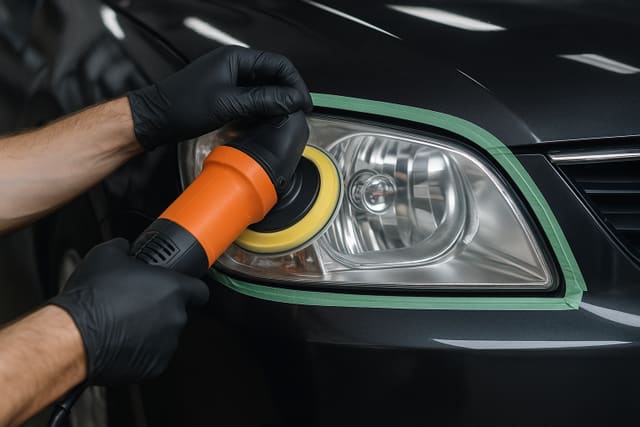
Most modern headlight lenses are plastic with a protective coating from the factory. Sunlight wears that coating away, the bare plastic clouds over, and less light reaches the road. A cloudy lens can often be sanded, polished and sealed again, and the job is usually quicker than people expect.
If your headlights have gone cloudy or yellow, the plastic lens has lost its protective coating and the surface has been weathered by sunlight. In most cases the lens can be cleaned back, polished and sealed again. We do this at our workshop in Smallfield, near Horley and Gatwick, and the lens itself rarely needs replacing.
Why do plastic headlights go cloudy and yellow?
Older cars had glass headlights. Most cars now have lenses made from polycarbonate, which is a tough, clear plastic. It is light and hard to break, but bare polycarbonate does not cope well with sunlight. So the maker puts a clear protective coating on the outside of the lens.
That coating does not last for ever. Sun, heat, road grit, car washes and years of weather wear it thin. Once it has gone in patches, ultraviolet light (the part of sunlight that fades and weakens plastics) attacks the plastic underneath. The surface roughens and turns hazy. Often it goes yellow or brown as well.
One trade article on headlight coatings describes it in the same way: the factory coating wears off, ultraviolet light then clouds and fades the lens, and less light comes out of the lamp.
Cars that live outdoors and face the sun tend to show it first. Cars kept in a garage take longer. The bulb is not the problem, and replacing it will not clear the haze.
How do you know it is the lens and not the bulb?
Look at the lens in daylight, not at night. Two things point to the outside of the lens:
- The surface looks frosted, yellowed or patchy, and it feels slightly rough.
- The haze is on the outside. If you have a hazy look from the inside, there may be water or condensation in the unit, and that is a different job.
Both lamps rarely age at exactly the same rate. One side is often worse, usually the side that gets more sun when the car is parked.
How does headlight restoration work?
Restoring a lens means removing the damaged outer layer and then putting a new protective layer on. The steps are the same in principle wherever it is done, although tools and products vary from shop to shop.
- Clean and mask. The lens is washed and the paint around it is taped off so nothing gets scratched.
- Sand the surface. The weathered layer is taken off with sandpaper, starting with a coarser grade and moving to finer ones. This leaves an even, matt surface and gets rid of the yellowing, because the damage is in the top layer of the plastic.
- Polish. A machine polish brings the clarity back. The lens goes from dull white to clear.
- Seal. A clear coating with ultraviolet protection goes on. This step matters most for how long the result lasts, because a polished lens with nothing on it will start to weather again.
One manufacturer of headlight coatings says its sealer is cured either in sunlight or with a handheld ultraviolet lamp, and that the surface is dry to the touch within minutes. Products differ, so we would not quote a figure for how long yours takes to harden. Ask us when you bring the car in.
Will it last?
Honestly, no restored lens is quite the same as a new factory coating. How long a restored lens stays clear depends on the sealer, how the car is parked and washed, and how weathered the lens was to begin with. A badly crazed or cracked lens, or one that is clouded on the inside, may not be worth restoring. We cannot tell from a photo, and we will tell you straight if a lens is beyond saving.
Does it matter for the MOT?
It can. The government's MOT inspection manual for cars lists what testers check on headlamps. They look at the condition of the lamp, whether it is secure, how it works and where it points. For the lens and reflector, the manual grades the defect by how bad it is. A lens or reflector that is slightly defective is a minor defect. One that is seriously defective, or missing, is a major defect, which is a fail.
The manual also lists, as a major defect, anything on the lens or light source that noticeably cuts the light output.
The tester decides on the day, so we cannot promise that a cloudy lens will pass or fail. What we can say is that a lens which lets plenty of light through is much less likely to cause a problem than one that has gone milky. If you have a test coming up and your headlights look poor, restoring them first is worth thinking about. You can read the government's MOT inspection manual section on lamps for yourself.
What does it look like when it is done?
You will see the difference from the pavement. The yellow goes, the lens looks clear again, and at night the beam looks whiter and reaches further down the road. It will not hide stone chips, cracks or damage that goes right through the plastic.
If the plastic around the lamp, or the bumper next to it, is scuffed, tell us when you ask for a price. We can look at the whole front end, and our bumper repair service covers the bumper itself. If the bodywork needs a polish at the same time, our car polishing and detailing page explains what we do there.
Getting a price from us
Our published price for headlight restoration is 35 pounds per headlight, so 70 pounds for both, plus VAT. It is often done in under an hour. See our headlight restoration page for the details, or send photos of your lenses on WhatsApp on 07724 146 809. You can also ring 01342 649 362 or email info@ericraft.co.uk. The quote is free and there is no pressure, and there is more on the contact page.
Questions people ask
Can cloudy headlights be fixed without replacing them?
Often, yes. If the haze is on the outside of the lens, sanding, polishing and sealing can bring it back to clear. A lens that is cracked, or misted on the inside, is a different case and we would look at it first.
Why did my headlights go cloudy so quickly?
Strong sun, heat and years of washing wear down the factory coating on the plastic. Once the coating is gone, ultraviolet light damages the bare plastic. Cars parked outside age faster than cars kept in a garage.
Will new headlight bulbs clear the haze?
No. The haze is on the lens, so a new bulb will still shine through a cloudy surface. It may be a little brighter but the lens is the problem.
Can a cloudy headlight fail an MOT?
It can. The MOT manual treats a seriously defective lens, or anything that noticeably cuts the light output, as a major defect. The tester decides on the day, so check by looking at your lamps in daylight and thinking about how much light gets out.
Does restoration use a lot of material from the lens?
It removes a thin top layer of the plastic and replaces it with a sealer. If the lens is badly damaged it may not suit this, and we will say so.
Sources and further reading
- GOV.UK, MOT inspection manual, lamps, reflectors and electrical equipment
- US trade magazine article, headlight restoration made easy
This page gives general information, not legal or insurance advice. Check your own policy and the official pages above.